Showing posts with label Jazz. Show all posts

Saturday, 26 September 2015

Mace2theO Webcast #12 - Mellow


Mace2theO Webcast #12 - Mellow


A re-issue now up on mixcloud


Sit back, light a candle and relax


Tracklist

1. Maybe I'm Amazed (live) - Bettye LaVette
Paul McCartney’s “Maybe I’m Amazed” is transformed from a majestic pop song into a stark, almost desperate expression of devotion by Bettye Lavette.  She recorded her first single at 16 in 1962 and finally achieved fame in 2005 with her album, 'I've Got My Own Hell to Raise.' Her eclectic musical style combines elements of soul, blues, rock and roll, funk, gospel, and country music, which has prevented her from being easily marketed - which makes me like her even more.  This live version is from a vid my boy Extplay took when he saw her in concert.

2. Last Train to Clarksville - Cassandra Wilson
A Grammy award winning jazz singer, Cassandra is one of those artist who has been successful at re-inventing herself so that she does not become boxed in.  She followed her Grammy award winning jazz album "Blue Light 'Til Dawn" with "New Moon Dawn" which ditched the traditional jazz setting (ie no piano for starters) for a darker tone.  that allowed her to turn the Monkees' pop gem "Last Train to Clarksville" into a slow-burning erotic vignette.

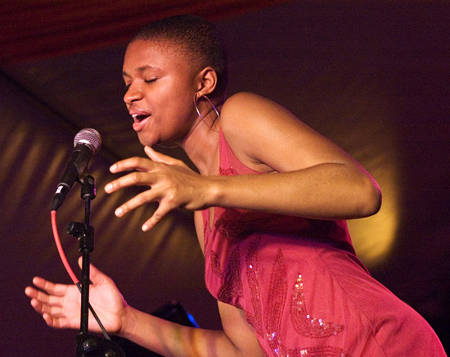
3. Thank You - Lizz Wright

Lizz Wright finally started getting the recognition she deserved with her third album 'The Orchard.' She does a wonderful blend of jazz, folk, gospel, and soul - best exemplified on this Led Zep (?!?) cover.  Saw her live at outdoor festival and she was mesmerizing.
 
4. Hopeless - Dionne Farris
Another of my personal favorites, Dionne first came to my attention when she was with Arrested Development and sang the killer vocals at the end of "Tennessee".  After her first solo album, she did this song written by Van Hunt for the 'Love Jones' soundtrack.

5. Hidden Charm (original version) - Van Hunt
van Hunt was born in Dayton, Ohio and his father, Van Hunt, Sr., was a factory worker, who was a friend of Ohio Players drummer Jimmy "Diamond" Williams.  After college, he moved to Atlanta where he started producing a few hip-hop demos for Atlanta rappers in order to pay bills. Hunt met up-and-coming record producers and artists like Dallas Austin, Jermaine Dupri and TLC through his work on demos. He wrote songs for artists such as Dionne Ferris before releasing his debut album in 2004. This is his version of one of the other songs he wrote for her.


6. Lookin' for Another Pure Love - Stevie Wonder (with Jeff Beck)
Released after Wonder toured with the Rolling Stones in 1972, 'Talking Book' became an immediate hit. The popular appeal of the recording helped destroy the myth that R&B artists were incapable of creating music that could be appreciated by rock audiences, and marked a unique period for R&B artists. Talking Book saw Wonder enjoying more artistic freedom from Motown. Guest appearances include Jeff Beck, Ray Parker, Jr., David Sanborn, and Buzzy Feton (Howard "Buzz" Feiten). While "Superstition" and "You Are The Sunshine of My Life" were the hits, it was album cuts like this one that made the album special (and one of my all time favorite albums).

7. Keep Your Head to the Sky - Earth Wind & Fire
'Head to the Sky' is the 4th studio album by Earth, Wind & Fire, released in 1973 and was EWF's first commercially successful album. This classic song - another personal favorite - "will treat your ears to what sounds like angels ascending from heaven as the sitar/fender rhodes intro began with Verdine purculating underneath on bass and Al Mackay and Johnny Graham doing their thing subtlely.  Then a 21 yr old Phillip Bailey, one of the greatest falsetto voices ever, at the height of his gifts, began to sing and I was transfixed!  When that angelic sounding chorus kicked in, I felt like I had left my body! And just when I thought I couldn't go any higher..Philip and Jessica Cleaves, who would leave the group soon after this album was released (later one of the Brides of Funkenstein), chimed together like songbirds from nirvana! That did it!...I was disciple from then on!" (MUZIK4THAPEOPLE)

8. Love T.K.O - Teddy Pendergrass

Pendergrass first rose to fame as lead singer of Harold Melvin & the Blue Notes in the 1970s before a successful solo career at the end of the decade.  "Love T.K.O." is from his 1980 album 'TP' and reached #2 on the Billboard R&B charts. It has been covered by several artists, including Deborah Harry, Regina Belle, Hall & Oates, Bette Midler, Boz Scaggs and Michael McDonald, and is responsbile for many babies born in the 70s.

9. God Bless the Child - Billie Holiday    

"God Bless the Child" is a song written by Billie Holiday and Arthur Herzog, Jr. in 1939, first recorded in 1941. In her autobiography 'Lady Sings the Blues' Holiday indicated an argument with her mother over money led to the song. She indicated that during the argument she said the line "God bless the child that's got his own." The anger over the incident led her to turn that line into a starting point for a song, which she worked out in conjunction with Herzog.

10. At Last - Etta James
"At Last" is a song performed by legendary R&B singer Etta James, ultimately becoming her signature song.  Chess Records head producer, Leonard Chess imagined James as a classic ballad stylist who had potential to cross over onto the Pop charts. Chess began backing James up on her recording sessions with violins and other string instruments, which was first heard on this 1961 hit.  Rolling Stone ranked Etta number twenty-two on their list of the 100 Greatest Singers of All Time.

11. My One and Only Love - John Coltrane and Johnny Hartman   
Most of you are probably familiar with Coltrane, but less so with Johnny Hartman. Hartman has such a beautiful voice that one of boys decribed it as "making Frank Sinatra sound like he was singing in a garbage can.  This is from (yet again) another of my favorite albums - 'John Coltrane and Johnny Hartman' is a 1963 studio album featuring the great saxophonist and vocalist.  Hartman is the only vocalist with whom Coltrane would record as a leader. 'Nuff said.


12. Walking A Tightrope - Johnny Adams
Johnny Adams, was a New Orleans born blues and jazz singer, known as "The Tan Canary" for the multi-octave range of his singing voice, his swooping vocal mannerisms and falsetto. He could sing a ballad like the cool Jazz cats but also sing a very deep and sad blues. This is the title cut from his tribute to songwriter Percy Mayfield ("Hit the Road Jack").

13. This Masquerade - George Benson
For many 80's folk, it may actually be news that George Benson was a jazz guitarist for 20 years before his pop career with Quincy Jones. Born and raised in Pittsburgh, PA (my home town!), Benson recorded his first solo album at 21 years old.  By the mid to late 1970s, 14 years and 14 albums after his debut, a whole new audience began to discover Benson for the first time. With the 1976 release 'Breezin', Benson began to put his vocal on tracks such as "This Masquerade". He had used his vocals infrequently on songs earlier in his career, notably his rendition of "Here Comes the Sun" on the Other Side of Abbey Road album. Breezin was a significant album in terms of popular music history - the first jazz release to go Platinum and the first indication that something new was about to happen. "This Masquerade" won a Grammy Award for Record of the Year

Listen now here

Listen later here


Monday, 18 April 2011

Mace2theO Webcast #19 Jazz Funk

Maceo Webcast #19 Jazz Funk


Jazz Funk
Jazz-funk is a sub-genre of jazz music characterized by a strong back beat (groove), electrified sounds, and often, the presence of the first electronic analog synthesizers. The integration of funk, soul, and R&B music and styles into jazz resulted in the creation of a genre whose spectrum is indeed quite wide and ranges from strong jazz improvisation to soul, funk or disco with jazz arrangements, jazz riffs, and jazz solos, and sometimes soul vocals. Jazz-funk is primarily an American genre, where it was popular throughout the 1970s and the early 1980s, but it also achieved noted appeal on the club-circuit in England during the mid 1970s. 


http://farm1.static.flickr.com/3/4060623_4c32d38f91.jpg

At its conception, the jazz-funk genre was occasionally looked down upon by jazz hard-liners as a sell-out, or "jazz for the dancehalls." It was unsubstantially presumed by these to be not intellectual or elite enough, which led to controversy about the music crossing over, but it was making jazz much more popular and mainstream.

The jazz-funk (as well as a proportion of the jazz) community absorbed the street sound of the funk rhythm, which gave the genre a dance-able rhythm and gained influences from the electric and some new analog electronic sound of fusion. The 1970s included many original stylistic creations, and the jazz-funk genre was very representative of this movement.(wiki)


CKJ 505 wrote at EMC:
As I am on the wrong side, the way wrong side of 30, I am leaning towards the jazz side of funk.It’s hard to put a finger on what funk is, but jazz funk makes me feel good, 
It’s smooth and free, simpler chords with solid chord progressions.  

....For CKJ 505


Track list

1. It Remains to be Seen – Bennie Maupin
"It Remains to be Seen" kicks off bass clarinetist Bennie Maupin's first LP for Mercury ('Slow Traffic To The Right') with a steady funk groove layered with reverb heavy orchestrated horns and electronic atmospheres. The beat is unobtrusive and seems to pre-date 90s acid jazz and trip-hop. Bennie and pianist Patrice Rushen turn in high energy solos that lift the song. A great bit of spiritual funky jazz that is an excellent groove. 


2. Hideaway (live) – David Sanborn
Alto saxophonist David Sanborn has earned fame beyond that of the average studio musician, and rightfully so. Sanborn has been among the session elite working with Stevie Wonder, Paul Simon, and David Bowie (I loved Sanborn's sax on the album 'Young Americans). This version of "Hideaway" is from the live-in-studio album 'Straight to the Heart'- often regarded by many as one of Sanborn's best as it features a stripped-down, funky showcase for his distinctive saxophone sound. Not only is the leader on top form, but he finds himself in good company. Marcus Miller contributes some great bass lines and solos, whilst there are fine touches by guitarist Hiram Bullock. 

3. Hurricane Season – Trombone Shorty
“Supafunkrock” is the name that Trombone Shorty gives his engaging blend of brass band blasts, metal guitar and deep grooves. From his debut album on Verve 'Backatown' this is the opening stomper “Hurricane Season”

4. Chameleon/We Want the Funk – Los Hombres Caliente
Los Hombres Calientes consists of the core group of Bill Summers (percussion), Irwin Mayfield (trumpet) and Jason Marsalis (drums) and they are supplemented by piano, bass and percussion.  The band is a meeting of young and old as Summers is a veteran of the jazz scene (his most notable sessions was part of Herbie Hancock’s Headhunters) and both Mayfield and Marsalis are in their early twenties. Here they funk it up with Herbie Hancock’s "Chameleon" and George Clinton’s "We Want the Funk."

5. McEwan’s Export – Average White Band
A live version of this track was played by the Average White Band (AWB) on the Atlantic Family Live at Montreux album with Morrissey Mullen, but the studio version didn't make the cut of AWB's second album (the 1974 self titled white Album most mistake as their first). This is the from the pre-Arif Mardin-production version of that album. 

6. (late night at the )
Maple Leaf – Stanton Moore
Stanton Moore is also the drummer in the funk band Galactic and the avant-funk group Garage a Trois.  Here with keyboardist Robert Walter and guitarist Will Bernard, they rock the house. His deceptively complex drumming on “(late night at the) Maple Leaf” creates the illusion that he is playing half a measure behind or ahead of the beat while the group turns in some penetrating hard funk. 

7   Eric – Marcus Miller
Multi-instrumentalist Miller is a well-known staple within the jazz and blues communities. Best known as the bassist for Miles Davis and David Sanborn, he is a clarinet player, keyboardist, saxophone player, guitarist, and vocalist. Many of these facets are heard his 1995 album 'Tales.'  This track features a great call and response with Hiram Bullock on guitar and Marcus on bass.

8. Stroke ’75 – Tower of Power
Tower of Power blew literally out of the Bay Area's early '70s scene at a time when hip black and white tastes were further diverging. The horn-heavy ensemble managed to find an audience of album buyers on both the soul and rock sides of the divide, though. This great and all too brief B-side “Stroke ’75″ shows off the "funkifized" soul of their world-famous horn section

9. Time – Lenny White
This album finds the Ex-Return To Forever drummer being produced by Earth, Wind & Fire keyboardist Larry Dunn, which brings a r'n'b sound to the mix of jazz-rock fusion.  This little funky pop vocal gem is called "Time."

10 Chocolate Chip – Miles Davis
'Doo-Bop' was Miles Davis' final studio album, which would have marked the beginning of the artist's turn to hip-hop-oriented tracks. The project stemmed from Davis sitting in his New York apartment in the summer with the windows open, listening to the sound of the streets. He wanted to record an album of music that captured these sounds. In early 1991, Davis called up his friend, hip hop mogul Russell Simmons and asked him to find some young producers who could help create this kind of music, leading to Davis' collaboration with Easy Mo Bee. This is one of the too-funky results. 

11. Lopsy Lu-Silly Putty – SMV

The album 'Thunder' is a collaboration between three of jazz fusion's reigning heavyweight bassists -Stanley Clarke, Marcus Miller, and Victor Wooten. The track here from that album is "Lopsy Lu-Silly Putty" - a medley of sorts. Some "Lopsy Lu" from Stanley Clarke's self-titled album (1974), some "Silly Putty" from Stanley's album Journey To Love (1975) added with a bass-line from "School Boy Crush" from The Average White Band's album "Person To Person" (1976). The tune is peppered by George Duke's mini moog. The funky sound of the '70's transferred to contemporary bass. Yum


Listen later here
 

Posted at 2tha9s.com on March 12, 2011 by SeeNote 
Maceo’s funky creation comes to you today from the webcasting  forum of the Entropy Music Club or “EMC” and boy, this funkateer seamlessly struts through the podcast like a cool breeze on a Sunday afternoon.


Mace2theO Webcast #18 - Return to New Orleans


Mace2theO Webcast #18 - New Orleans #2


Back to New Orleans....in time for Mardi Gras

Come celebrate the indigenous music and culture of New Orleans and Louisiana, with music that encompasses blues, R&B, funk, gospel music, Cajun music, zydeco, Afro-Caribbean, folk music, funk, country music, bluegrass and everything in between. And of course there is lots of jazz...and did I mention funk?


Mardi Gras
Mardi Gras (Fat Tuesday in English) in New Orleans, Louisiana, is a Carnival celebration well-known throughout the world.

The New Orleans Carnival season, with roots in preparing for the start of the Christian season of Lent, starts after Twelfth Night, on Epiphany (January 6). It is a season of parades, balls (some of them masquerade balls), and king cake parties. It has traditionally been part of the winter social season; at one time "coming out" parties for young women at débutante balls were timed for this season.


Celebrations are concentrated for about two weeks before and through Fat Tuesday (Mardi Gras in French), the day before Ash Wednesday. Usually there is one major parade each day (weather permitting); many days have several large parades. The largest and most elaborate parades take place the last five days of the season. In the final week of Carnival, many events large and small occur throughout New Orleans and surrounding communities.

The parades in New Orleans are organized by Carnival krewes. Krewe float riders toss throws to the crowds; the most common throws are strings of plastic colorful beads, doubloons (aluminum or wooden dollar-sized coins usually impressed with a krewe logo), decorated plastic throw cups, and small inexpensive toys. Major krewes follow the same parade schedule and route each year.


While many tourists center their Mardi Gras season activities on Bourbon Street and the French Quarter, none of the major Mardi Gras parades has entered the Quarter since 1972 because of its narrow streets and overhead obstructions. Instead, major parades originate in the Uptown and Mid-City districts and follow a route along St. Charles Avenue and Canal Street, on the upriver side of the French Quarter.

To New Orleanians, "Mardi Gras" specifically refers to the Tuesday before lent, the highlight of the season. The term can also be used less specifically the whole Carnival season, sometimes as "the Mardi Gras season". The term "Fat Tuesday" or "Mardi Gras Day" always refers only to that specific day. (wiki)


Track list
1. Burgundy Street Blues - Dr. Michael White
Crescent City clarinetist Dr. Michael White celebrates the 100th anniversary of the birth of the legendary New Orleans clarinetist George Lewis by performing Lewis' signature piece, the elegant "Burgundy Street Blues," which drips with Spanish moss and humid nights with its melancholy melody.

2. Accentuate The Positive - Paul Sanchez & John Boutte

Singers John Boutte and Paul Sanchez got together and knocked out a record in a single session. What you hear is well-played, well-sung yet laid back session of singer-songwritery, blues jazz. Boutte shows how inventive an interpreter he is on a cover of the Johnny Mercer/Harold Arlen classic “Accentuate the Positive,”

3. Exit To Mystery Street - Paul Sanchez
Singer-songwriter Sanchez' offers up more than most on this solo record made with friends, including the wonderful Matt Perrine tuba track lines on this title track from the album of the same name.

4. On Your Way Down - Trombone Shorty    

Allen Toussaint appears on one cut from Trombone Shorty's debut album 'Backatown.' While he doesn’t lend vocal support, he does play piano on a cover of his classic “On Your Way Down,” a tune that was most recently covered by Toussaint and Elvis Costello. This Trombone Shorty version dances circles around all the other; it’s a loose, funky groove, Toussaint’s piano lines and what sounds like a flute flirting with a dynamite, in-the-pocket rhythm that makes past incarnations of the song sound leaden by comparison. It’s a fairly radical reinvention of a beloved tune, but Toussaint’s presence here seems to signify his approval.

5. Josephine (live) - David Torkanowsky & George Porter Jr. & Herman Ernst
From a radio tribute to the late legend Snooks Eaglin, this is a live version of Snook's "Josephine" with Meters bassist George Porter Jr with Herman Ernst on drums and David Torkanowsky on piano.  Too funky

6. Mr. Big Stuff - Kermit Ruffins w/Rebirth Brass Band
Trumpeter Kermit Ruffins came blasting out of high school with the Rebirth Brass Band, The ensemble stormed for 10 years before disbanding in 1992. Here reconvened, they've lost none of their flair and verve. The Rebirth Brass Band are in fine form, particularly the mighty tuba playing of Philip Frazier, with this cover of Jean Knight's hit - celebratory, soulful and perfect party music yet tied to the brass band tradition.

7. Backwater Blues - Irma Thomas
Thomas is a contemporary of Aretha Franklin and Etta James, but never experienced their level of commercial success. Here, she covers the Bessie Smith tune and it's relevant theme for "Our New Orleans: A Benefit Album for the Gulf Coast" which presents songs recorded in September and October 2005, shortly after Katrina

8. I'll Be Seeing You - James Booker
A mentor of Harry Connick Jr, Booker was highly skilled in classical music and played Bach and Chopin, among other composers. He also mastered and memorized solos by Erroll Garner, and Liberace. His thorough background in piano literature may have enabled his original and virtuosic interpretations of jazz and other American popular music. These performances combined elements of stride, blues, gospel and Latin piano styles. Here, alone on the piano.

9. Unnecessarily Mercenary -Jon Cleary
Kent UK born and New Orleans based, Cleary is a triple threat—with a salty-sweet voice, masterful piano skills, and a knack for infectious grooves.  Later covered by Bonnie Raitt, here Cleary tickles the ivories with a solid boogie foundation with his own take on gold diggers. I love me some Jon Cleary

10. Someone to Love - Eden Brent
Singer and pianist Eden Brent from Greenville, Mississippi recorded this record in New Orleans. She brings her own boogie-woogie style now infused with the City's jazz and soul and, all dipped in Mississippi Delta Blues. Eden's voice gives her gritty music a much raspier and earthy sound.

11. Door Poppin' - John Boutte
Born into a large and musical Creole family, Mr. Boutté has roots in gospel and traditional jazz. While he can tap out syncopated beats on a tambourine, it is the sweetness and grit of his tenor voice that may remind of Sam Cooke but fits no convention. This is a funky track written with Paul Sanchez. "Please get out of the door, fool"

12. Sneakin' Sally Through The Alley - Lee Dorsey
I hate to admit it, but I heard first this song as covered by the late Robert Palmer in 1974, backed by members of the Meters. Later I found out that Toussaint wrote it and Lee Dorsey performed it first.  Dorsey was a versatile performer, capable of rocking R&B, soul, and sang many of Toussaint's songs. The Meters play backing here on the original, with some popping guitar and a stop-time beat that keeps things chugging along in a funky way.

13. Yes We Can, Can - The Pointer Sisters

This Allen Toussaint-penned gem comes from the Pointer's debut album from 1973.  A socially conscious theme that features intricate background vocals by three of the sisters while Anita Pointer handled lead.  That bassline is so funky you will get that 'I-smell-somethin' face as you start moving your head side to side.

14. Tootie Ma Is a Big Fine Thing - Preservation Hall Jazz Band & Tom Waits    
The Preservation Hall Jazz Band derives its name from Preservation Hall, the venerable music venue located in the heart of New Orleans’ French Quarter, founded in 1861. Waits traveled to New Orleans to record songs with the Preservation Hall Jazz Band for 'PRESERVATION: An Album To Benefit Preservation Hall.' Originally recorded by Danny Barker in 1947, “Tootie Ma Was A Big Fine Thing” is one of the earliest known recorded examples of Mardi Gras Indian chants.

Many thanks to Sal over at Burning Wood for turning me on to much of the above.


Listen later here


Friday, 8 April 2011

Maceo Webcast #11 - Big Band Jazz

Maceo Webcast #11 - Big Band Jazz 
"Sho 'nuff guaranteed to get your foot tappin' 
and your fingers snappin'"

BIG BAND
The big band is a type of musical ensemble associated with jazz, a style of music which became popular during the Swing Era from the early 1930s until the late 1940s. Big bands evolved with the times and continue to today. A big band typically consists of approximately 12 to 25 musicians and contains saxophones, trumpets, trombones, singers (or vocalists), and a rhythm section. The terms jazz band, jazz ensemble, stage band, jazz orchestra, society band and dance band may be used to describe a specific type of big band.


There was a considerable range of styles among the hundreds of popular bands. Many of the better known bands reflected the individuality of the bandleader, the lead arranger, and the personnel. Count Basie played a relaxed propulsive swing, Benny Goodman a hard driving swing, and Duke Ellington’s compositions were varied and sophisticated. Many bands featured strong instrumentalists, whose sounds dominated, such as the clarinets of Benny Goodman, Artie Shaw and Woody Herman, the trombone of Jack Teagarden, the trumpet of Harry James, the drums of Gene Krupa, and the vibes of Lionel Hampton. The popularity of many of the major bands was amplified by star vocalists, such as Frank Sinatra with Tommy Dorsey, Ella Fitzgerald with Chick Webb, Billie Holiday and Jimmy Rushing with Count Basie, Doris Day with Les Brown, and Peggy Lee with Benny Goodman.


SWING
Swing music, also known as swing jazz or simply swing, is a form of jazz music that developed in the early 1930s and became a distinctive style by 1935 in the United States. Swing uses a strong rhythm section of double bass and drums as the anchor for a lead section of brass instruments such as trumpets and trombones, woodwinds including saxophones and clarinets, and sometimes stringed instruments such as violin and guitar; medium to fast tempos; and a "lilting" swing time rhythm. Swing bands usually featured soloists who would improvise on the melody over the arrangement. The danceable swing style of bandleaders such as Benny Goodman and Count Basie was the dominant form of American popular music from 1935 to 1945.

The verb "to swing" is also used as a term of praise for playing that has a strong rhythmic "groove" or drive.

 
With the wider acceptance of swing music around 1935, larger mainstream bands dropped their string instruments, which were now felt to hamper the improvised style necessary for swing music. This necessitated a slightly more detailed and organized type of composition and notation than was then the norm. Band leaders put more energy into developing arrangements, perhaps reducing the chaos that might result from as many as 12 or 16 musicians spontaneously improvising. But the best swing bands at the height of the era explored the full gamut of possibilities from spontaneous ensemble playing to highly orchestrated music in the vein of European art music.

Swing jazz began to be embraced by the public around 1935. Prior to that, it had had limited acceptance, mostly among African American audiences. Radio remotes increased interest in the music, and it grew in popularity throughout the States. As with many new popular musical styles, it met with some resistance from the public because of its improvisation, fast erratic tempos, lack of strings, occasionally risqué lyrics and other cultural associations, such as the sometimes frenetic swing dancing that accompanied performances. Audiences who had become used to the romantic arrangements (and what was perceived as classier and more refined music), were taken aback by the often erratic and edginess of swing music. (wiki)

Tracklist

1. April In Paris - Count Basie
Basie was a pianist, organist, bandleader, and composer. He hit the pop charts with this now-famous 1955 performance, and kept the song in his repertoire for the rest of his career. Basie leads his band through fake endings (with his sly voice urging the band on "One more time") until finally bringing the song to its boisterous conclusion. 

2. In the Mood - Glenn Miller
Miller - a trombone player, composer and bandleader- and his Orchestra were the kings of big band during the War time hey day of the swing era. He was one of the best-selling recording artists from 1939 to 1943. His other hits included Chattanooga Choo Choo, Tuxedo Junction, and Pennsylvania 6-5000.  While he was traveling to entertain U.S. troops in France during World War II, Miller's plane disappeared in bad weather over the English Channel. His body has never been found.

3. Sing Sing Sing - Benny Goodman
The "King of Swing" Benny Goodman led one of the most popular musical groups in the mid-1930s. His January 16, 1938 concert at Carnegie Hall in New York City is described by critic Bruce Eder as "the single most important jazz or popular music concert in history: jazz's 'coming out' party to the world of 'respectable' music. During an era of segregation, Goodman led one of the first racially-integrated musical groups (before Sly!). "Sing, Sing, Sing" is probably the most famous tune associated with Goodman, but the most recognizable part of the song is Gene Krupa's drumming, which exists as a motif throughout the song.

4. Blue Skies  - Frank Sinatra (With Tommy Dorsey & His Orchestra)
5. Come Fly With Me (Live) - Frank Sinatra with Count Basie & The Orchestra & Quincy Jones

Sinatra began his career in the swing era with Harry James and Tommy Dorsey, before the bobby soxer idol, acting, great jazz albums and Vegas rat pack years.  These two track are a 'then and now.' First, Sinatra as the featured singer with Dorsey on Irving Berlin's 'Blue Skies' (an outtake Version from the movie 'Ship Ahoy', 1942). This is followed with the Chairman of the Board at the peak of his Rat Pack years, recorded in 1966 at the Sands hotel in Las Vegas. The live album became the de facto standard for arranging big band brass, arranged and conducted by the then youthful-pre-MJ-but-already-accomplished Quincy Jones.

6. Four Brothers - Woody Herman & His Orchestra

Four saxophones!!!  Herman was a clarinetist, alto and soprano saxophonist and singer, as well as a big band leader popular in the 1930's and 40's. "Four Brothers" is a jazz standard made famous by Herman's Orchestra.  The song features four saxes (three tenors and one baritone) in an arrangement that gives each "brother" a solo and culminates in a hard-swinging sax section chorus. The title also became a play on the four musicians that performed in the original version: Stan Getz, Zoot Sims, Herbie Steward, and Serge Chaloff.

7. Main Stem (Live)- Duke Ellington
"Duke" was a composer, pianist, and big band leader, and wrote over 1,000 compositions. In the words of Bob Blumenthal of The Boston Globe "In the century since his birth, there has been no greater composer, American or otherwise, than Edward Kennedy Ellington."  This is from the "Private Collection" or Ellington's Vault in purple terminology.  He kept recording his big band at his own expense during the 50's-70s when big band music was no longer popular.  This is from Volume 2 (of 10) and is a live dance concert from 1958.  As it was initially recorded not for release, you can hear all the banter between the musicians and Duke on stage as the concert progresses - they were having a blast! Duke is my favourite big band leader, btw.

8. Goody, Goody - Ella Fitzgerald with Quincy Jones and His Orchestra
9. Mack the Knife (Live) - Ella Fitzgerald with Duke Ellington and His Orchestra

Ella Jane Fitzgerald was a vocalist also known as the "First Lady of Song" and "Lady Ella," with a vocal range spanning three octaves (Db3 to Db6). she was noted for her purity of tone, impeccable diction, phrasing and intonation, and a "horn-like" improvisational ability, particularly in her scat singing. Once again with the 'then and now,' the first track is from 1952, and features a cool breakdown, with Quincy Jones and his Orchestra. The second features Ella live with Duke Ellington in 1966. After successfully improvising the lyrics for the song, "Mack the Knife" after forgetting them, it became a way for her to improvise when performing it live - free style rap ahead of its' time. 

10. Swingin' the Blues - Count Basie
Basie favored blues, and he showcased some of the most notable blues singers of the era: Billie Holiday, Jimmy Rushing, Big Joe Turner, Helen Humes, and Joe Williams.

11. Let the Good Times Roll - Ray Charles
Ray Charles was a pioneer in fusing rhythm and blues, gospel, and blues styles into his early recordings while he helped racially integrate country and pop music during the 1960s with his crossover success. While with ABC, Charles became one of the first African-American musicians to be given artistic control by a mainstream record company.

So he mixed different genres and owned his master recordings...reminds me of somebody...anyway, Ray does the blues with a big band.

12. Boogie Woogie (I May Be Wrong) (Live) - Count Basie
Recorded live at the Newport Jazz Festival in 1957 with Jimmy Rushing on vocals and Lester Young on tenor sax

13. Diminuendo and Crescendo in Blue [Live] - Duke Ellington   
Diminuendo and Crescendo in Blue" is a big band jazz composition written in 1937 by Duke Ellington. In its early form, the two individual pieces, "Diminuendo in Blue" and "Crescendo in Blue."  At the historic 1956 Newport Festival, Duke told tenor saxophonist Paul Gonsalves to blow as long as he wanted during the interlude, which Ellington later called "The Wailing Interval" or "Blow By Blow." In what has since become jazz folklore, Gonsalves almost created a riot as he played a tenor sax solo for 27 choruses that stirred up the normally staid crowd into a frenzy. A striking platinum blonde woman in a black evening dress, named Elaine Anderson, jumped from her box seat and started dancing.This helped serve as a catalyst for the crowd frenzy that grew as Gonsalves continued his forceful, energetic solo.

Listen now here

Listen later here


Sunday, 20 March 2011

Maceo Musicology Webcast #6 - New Orleans

Maceo Musicology Webcast #6 - New Orleans


featuring the music of the Crescent City


New Orleans
"New Orleans is a major U.S. port and the largest city in the state of Louisiana.


New Orleans has always been a significant center for music, showcasing its intertwined European, Latin American, and African cultures. New Orleans' unique musical heritage was born in its pre-American and early American days from a unique blending of European instruments with African rhythms. As the only North American city to allow slaves to gather in public and play their native music (largely in Congo Square, now located within Louis Armstrong Park), New Orleans gave birth to an indigenous music: jazz. Soon, brass bands formed, gaining popular attraction that still holds today. The city's music was later significantly influenced by Acadiana, home of Cajun and Zydeco music, and Delta blues.


The terms "Mardi Gras" refer to events of the Carnival celebrations, beginning on or after Epiphany and ending on the day before Ash Wednesday. Mardi Gras is French for "Fat Tuesday" (in ethnic English tradition, Shrove Tuesday), referring to the practice of the last night of eating richer, fatty foods before the ritual fasting of the Lenten season, which started on Ash Wednesday. Popular practices included wearing masks and costumes, overturning social conventions, dancing, sports competitions, parades, etc.


The tradition has expanded to the point that it became strongly associated with the city in popular perception, and embraced by residents of New Orleans beyond those of French or Catholic heritage. Mardi Gras celebrations are part of the basis of the slogan, Laissez les bon temps rouler, (Let the good times roll) and the nickname 'Big Easy'." (wiki)


Ymaginatif at Entropy MC said:

And I listened to it this afternoon! - alone in the office

Great collection of surprisingly funky songs!! Of course, I should have expected, with Funkmeister Maceo having a hand in this, but somehow I had expected more of the mardi gras tinkly Allen Toussaint piano and clarinetty brass bands. Wrong again Laughing

I love the breath-taking musicianship throughout and the funky tuba really made me smile (Elvis Costello once made a funk song with a tuba - I considered him out of his mind, but now I see what he was trying to do!)

Tonight I subjected this Podcast to the highly critical ears of Mrs Y ... affraid

You have to know, this is the very first podcast I've summoned the courage to do so! Maxim's podcasts might have been a bit too scary with the spooky voice, Purpleblues's might have been too bluesy, and I certainly wouldn't have played mine, because she would laugh outloud at my truly silly attempts at DJing. The Sound Of Scoop? Just not her style I think ...

But this one, this exuberant slice of piano, brass, and guitars music, topped off with Maceo's cool late-night voice ... this one I thought she might appreciate?

I waited for the right moment ... somewhat tired after a busy but fullfilling day. Good mood. Hannah joyfully playing by herself. A glass of white wine and the salmon frying in the kitchen. A few candles on (because the lamp isn't working). I carefully put the ipod in its player ... scrolled down to the section 'Maceo' and clicked play ...

The intro raised a few eye-brows (I have to admit ), but when the piano suddenly came in and switched to a swinging version of 'When The Saints Go Marchin' In', I saw that everything was alright! Hannah started dancing along (while at the same time making a drawing) and ... Eva liked it.

Halfway through she even commented that she really liked the music - and that she thought Maceo's voice really sounded like a professional DJ's!

Yes! Success!!! cheers

Anyway – all this to say: this is a really good podcast! I keep listening to it, and it should be compulsary listening material for every single Entropy member here!


Tracklist, with special thanks to Sal at Burning Wood

1. When the Saints Go Marching In - Sidney Bechet
A classic with the great Sidney Bechet on clarinet.

2. My Dawlin' New Orleans - Little Queenie & The Percolators
A more modern sound, this track was eventually featured on the tv show "Treme"

3. Shake What Your Mama Gave You - Henry Butler & Corey Harris
This little gem breaks current blues stereotypes in a number of ways. First of all, by being all-acoustic and without a rhythm section.  With Harris bring the acoustic blues feel and Butler bringing the jazz piano, this 2000 original sounds as if it was written in the 1930s.

5. Groove Me -         King Floyd
At first, "Groove Me" was a B-side to another Floyd song, "What Our Love Needs." New Orleans radio DJ's started playing "Groove Me" and the song became a local hit. The bass line is a master class in the use of space.

6. Ocean -         Bonerama
The trombone and tuba were definitely not cool instruments when I was growing up, but here they are weapons of funk.  Here is the brass rock funk group Bonerama covering a funky Led Zepplin track.

7. Right Place, Wrong Time - Dr. John
My 1st exposure to New Orleans through the Top 40.  Still the jam.

8. Louisiana 1927   -   John Boutté
My apologies to both Mr Boutte for mispronouncing his name and to Randy Newman for not knowing he wrote this timely tune. 

9. Kooks On Parade   -  Stanton Moore
This is what Madhouse would have sounded like if it had been a couple of New Orleans jazz musicians. Features Stanton Moore on drums

10.Zydeco Mardi Gras  -  C.J. Chenier
C. J. Chenier is the son of the Grammy Award winning "King of Zydeco", Louisiana musician, Clifton Chenier. Chenier followed in his father's footsteps, and led his father's band as an accordion performer of Zydeco, a blend of Cajun and Creole music. Here is some Zydeco funk.

11.Best Ain't Good Enuff  -  Jon Cleary
12.So Damn Good -   Jon Cleary & The Absolute Monster Gentlemen

Two track from Jon Cleary, who is a funk and R&B pianist and guitarist based in New Orleans for the last 20 years, but originally from Cranbrook in Kent, England.  The 1st cut is an acappella track and the 2nd features his funky band, The Absolute Monster Gentlemen.

13. If Serving God Is Wrong   -   Rev. J. Cheeks
Based on the soul classic "If Loving You is Wrong, I don't want to be Right", it's now time to go church

14. Mr. Big Stuff  -  Jean Knight

Recorded as the same Stax sessions as "Groove Me" and sampled by Heavy D, Queen Latifah, TLC and others, this was big crossover hit for New Orleans born Ms Knight.

15. Rockin Pneumonia and the Boogie Woogie Flu - Huey "Piano" Smith
I grew up with the Johnny Rivers version (he of "Secret Agent Man" fame), so it was great to turned on to the original.


Listen later Here